OLED Basics
OLEDs are organic LEDs, which means that their key building blocks are organic (i.e., carbon-based) materials. Unlike LEDs, which are small-point light sources, OLEDs are made in sheets that are diffuse-area light sources. Although OLED technology is developing rapidly, it's less mature than LED technology and is still some years away from becoming a practical source of general illumination. Virtually all OLED products on the market today are used for small-area displays, such as those in smartphones, vehicular audio systems, digital cameras, and other consumer electronics.
Structure of OLEDs
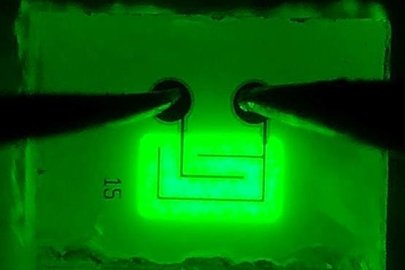
An OLED is a solid-state device consisting of a thin, carbon-based semiconductor layer that emits light when electricity is applied by adjacent electrodes. In order for light to escape from the device, at least one of the electrodes must be transparent. The intensity of the light emitted is controlled by the amount of electric current applied by the electrodes, and the light's color is determined by the type of emissive material used. To create white light, most devices use red, green, and blue emitters that can be arranged in several configurations, as illustrated below.
Source: Universal Display Corporation
Advantages of OLEDs
The energy-saving potential of OLEDs is similar to that of LEDs, but the two technologies differ in a number of ways. For one thing, whereas LEDs are concentrated sources of bright light, OLEDs can be configured as larger-area, more diffuse light sources, which may be more practical for general ambient lighting because the soft light can be viewed directly, with less need for shades, diffusers, lenses, louvers, or parabolic shells. The diffuse light from OLEDs allows them to be used very close to the task surface without creating glare for the user, which means that less total light can be used in order to achieve desired illuminance levels. And OLEDs can be made very thin, increasing their eye appeal and allowing for easy attachment to the surfaces of walls and ceilings. This, coupled with the diffuse nature of OLED lighting, could enable an entirely new type of light and light fixture that's both attractive and highly efficient. OLEDs can also be made in almost any shape, can be deposited on flexible substrates, and can be transparent, emitting light from both sides of the device—features that greatly expand the design possibilities, allowing for a completely new lighting experience.
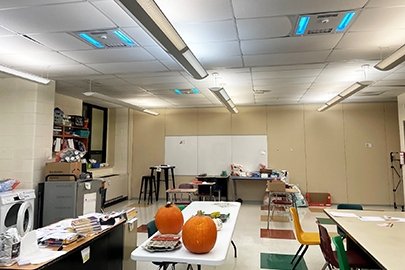
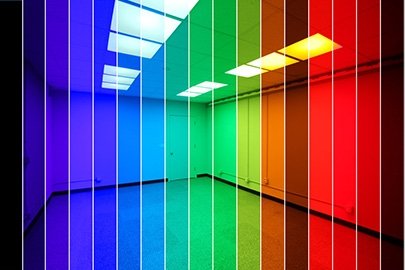
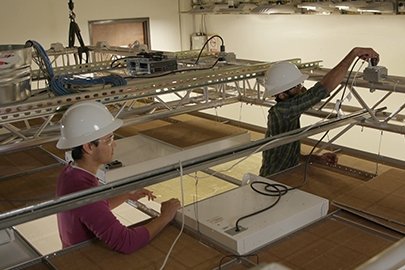
Commercial OLED offerings.
Future of OLEDs
OLEDs for general illumination are at a critical stage. Currently, OLED "panels" (the light-emitting devices used to construct a luminaire) are available with excellent color rendering (CRI 80–90) and efficacies of up to 60 lm/W, which are expected to reach 80 lm/W by late 2013. The lifetime of OLED panels is also improving, with many products expecting 10,000–15,000 hours of use before the light output decreases to 70 percent of the initial value. These advancements in efficiency and lumen maintenance are being realized while panels are getting brighter, allowing for smaller devices that achieve the same light output levels. But despite these advances, OLED costs need to come down considerably to make OLED lighting commercially viable. As further performance improvements are made and costs are reduced, OLED products will compete on the market and provide a revolutionary form of high-efficiency lighting.